
Empire Crypto: Powerful Blockchain Concepts Made Simple
Blockchain technology often feels like an impenetrable maze of technical jargon, complex math, and overwhelming jargon. However, understanding the core foundations of Web3 doesn’t require a degree in computer science. With Empire Crypto, powerful blockchain concepts are made simple so that anyone—from total beginners to seasoned investors—can confidently navigate the digital asset ecosystem.

Why Understanding Blockchain and Crypto Data Matters
The world of Web3 moves faster than any traditional market. Millions of transactions happen 24/7 across thousands of decentralized networks. For everyday users and professional traders alike, raw blockchain activity can easily become noise. That is where high-quality cryptocurrency market data becomes indispensable.
Understanding blockchain fundamentals allows you to:
- Separate Hype from Utility: Recognize which projects possess genuine technological value versus short-lived speculative bubbles.
- Make Data-Driven Decisions: Replace emotional trading with precise data analytics cryptocurrency metrics.
- Protect Your Assets: Understand on-chain security, smart contract mechanics, and wallet safety before executing transactions.
At Empire, our mission is to demystify complex on-chain architecture and provide the best crypto data insights to help you stay ahead of the curve.
Core Blockchain Concepts Explained Simply
To understand how Empire evaluates the market, it helps to start with the foundational building blocks of blockchain technology.
+-----------------------------------------------------------------------+
|                       HOW A BLOCKCHAIN WORKS                          |
+-----------------------------------------------------------------------+
|  1. Transaction Initiated  ==>  User sends crypto to another wallet   |
|  2. Block Bundling         ==>  Nodes pool transactions together      |
|  3. Consensus Reached      ==>  Proof-of-Work or Proof-of-Stake     |
|  4. Immutable Addition     ==>  Block added permanently to chain  |
+-----------------------------------------------------------------------+
1. Distributed Ledgers
Traditional banking relies on a centralized database managed by a single institution. In contrast, a blockchain is a distributed ledger maintained by a global network of computers (nodes). Every node keeps an identical copy of the transaction history, making unauthorized alterations virtually impossible.
2. Cryptographic Hashing
Each block of data contains a unique mathematical signature called a hash, alongside the hash of the previous block. This creates an unbroken chain. If a bad actor attempts to alter a past transaction, every subsequent hash breaks, alerting the network instantly.
3. Consensus Mechanisms: PoW vs. PoS
Blockchains rely on consensus mechanisms to validate transactions without needing a central middleman:
- Proof-of-Work (PoW): Miners solve computational puzzles to secure the network (e.g., Bitcoin).
- Proof-of-Stake (PoS): Validators stake native tokens as collateral to verify transactions efficiently and sustainably (e.g., Ethereum).
The Role of Crypto Data in Modern Trading
Navigating the market without reliable data crypto metrics is like driving at night without headlights. Raw transactions happen on-chain every second, but turning raw transactions into clear trends requires specialized crypto data solutions.
What is On-Chain Data Analysis?
Every interaction on a public blockchain is publicly visible. Trading data analysis cryptocurrency professionals study these public traces to track market movements before they reflect on traditional exchange order books.
Key on-chain metrics monitored by Empire include:
- Whale Wallet Movements: Tracking large transfers to and from exchanges to anticipate buying or selling pressure.
- Active Addresses: Measuring daily active users to gauge real network adoption versus artificial price manipulation.
- Exchange Inflows/Outflows: Monitoring net shifts of tokens entering or leaving central exchanges.
- Hash Rate & Network Health: Evaluating the processing power securing PoW chains.
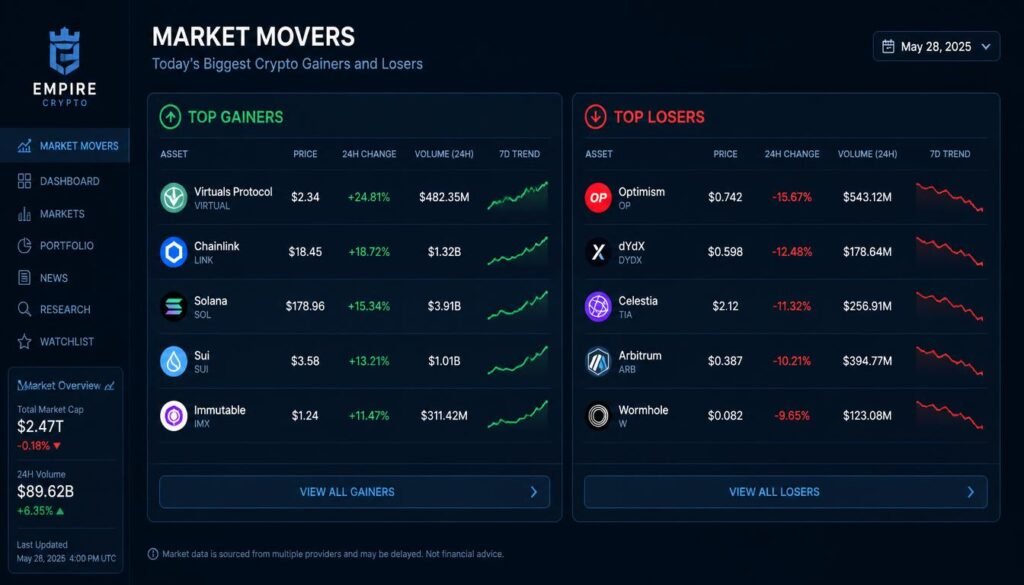
Navigating the Market: Beginner vs. Advanced Data Metrics
Depending on your experience level, different types of crypto data analysis will guide your strategy.
| Metric Level | Metric Type | Primary Focus | Best Used For |
| Beginner | Price & Market Cap | Asset Valuation | Identifying project size and historical price trends |
| Beginner | 24h Trading Volume | Market Liquidity | Ensuring ease of buying or selling without high slippage |
| Intermediate | TVL (Total Value Locked) | Ecosystem Growth | Measuring capital deposited in DeFi protocols |
| Intermediate | NVT Ratio | Relative Valuation | Comparing market cap to transaction volume to spot overvaluation |
| Advanced | MVRV Z-Score | Market Tops/Bottoms | Identifying historical extreme overbuying or overselling periods |
| Advanced | Realized Cap | True Capital Inflow | Assessing aggregate cost-basis of all coins across the network |
Beginner Essentials
If you are just starting, focus on baseline cryptocurrency data metrics like market capitalization, circulating supply, and total volume. These figures offer a quick snapshot of liquidity and market sentiment.
Advanced On-Chain Analytics
Intermediate and expert traders look deeper into data analytics cryptocurrency platforms. Metrics like the MVRV Z-Score or Realized Cap reveal whether an asset is overvalued or undervalued relative to its historic cost basis. Leveraging high cryptocurrency data reliability gives advanced traders a decisive edge in timing market cycles.
Real-World Examples & Use Cases
To see how Empire simplifies these concepts, let’s look at real-world scenarios where blockchain data makes a tangible difference:
Use Case 1: Identifying DeFi Yield Opportunities
Decentralized Finance (DeFi) offers high yield opportunities, but it also carries smart contract risks. By analyzing crypto market data, users can verify protocol health, inspect liquidity depth, and monitor Total Value Locked (TVL) stability before committing funds.
Use Case 2: Spotting Accumulation Phases
Before major market rallies, institutional investors often accumulate assets quietly. Through crypto data solution toolsets, users can detect large wallet accumulations over extended periods—long before news outlets report on price breakouts.
About Empire Data
At Empire, we believe that transparency and actionable intelligence are the backbones of Web3 success. As a premier crypto data company specializes in transforming messy, raw multi-chain ledger output into clear, structured, high-value insights.
Our platform provides custom crypto data solutions built for both individual retail investors and institutional analysts who require complete cryptocurrency data reliability.
Why traders trust Empire:
- Real-Time Feeds: Ultra-low latency feeds capturing live cryptocurrency market data across major blockchains.
- Deep Analytics: Comprehensive dashboards tracking wallet flows, DeFi protocols, and tokenomics.
- Simplified Insights: Translating complex cryptocurrency data analytics into intuitive visual reports.
Whether you are performing complex data crypto research or looking for simple market overviews, Empire empowers you with the ultimate best crypto data suite.
Frequently Asked Questions (FAQ)
What is Empire Crypto?
Empire Crypto is an educational and analytics platform dedicated to making complex blockchain concepts easy to understand while delivering top-tier crypto data insights for traders and Web3 enthusiasts.
Why is cryptocurrency data reliability so important?
Because Web3 markets operate continuously, inaccurate or delayed data can result in significant financial slippage. High cryptocurrency data reliability ensures that your trade executions and portfolio tracking reflect true real-time conditions.
How does on-chain crypto data analysis differ from technical analysis?
Technical analysis focuses primarily on price chart patterns and historical trading volume. On-chain crypto data analysis inspects direct blockchain activity—such as wallet transfers, miner balances, and smart contract usage—providing a structural look into network health.
Can beginners use Empire tools effectively?
Yes! Empire Crypto is specifically designed to bridge the gap between complex blockchain mechanics and user-friendly insights. Our tools break down advanced cryptocurrency data analytics into simple visual dashboards.
Master Web3 with Empire Crypto Today
The blockchain space evolves rapidly, but mastering its fundamentals does not have to be overwhelming. By breaking down complex architecture into intuitive concepts and pairing them with high-grade cryptocurrency market data, Empire Crypto helps you navigate the future of finance with clarity and confidence.
Don’t let market noise dictate your Web3 journey. Explore Empire Crypto, harness the power of premier data analytics cryptocurrency tools, and take full control of your crypto research today!
About The Author
